NEJINEJI expands on the principle of partial hardening with lacquer explored in KACHIKACHI. By repeatedly twisting sections of lacquer-coated cotton rope and allowing them to cure in that state, the twisted shapes are fixed. These hardened twists function not merely as shapes, but as “connection points.” Instead of relying on friction or compression like a knot, they connect by being inserted and interlocked through the twists. These rigid, twisted segments allow the rope to develop three-dimensionally in various directions.
「NEJINEJI」は、KACHIKACHIで探求した漆による部分硬化の原理をさらに発展させた作品です。漆を塗布したコットンロープの一部を複数回ねじり、その状態のまま硬化させることで、捻られた形状を固定します。 硬化したねじり部分は、単なる形ではなく“接続点”として機能します。結び目のように摩擦や圧縮に頼るのではなく、ねじれを使って差し込み、かみ合わせるように連結する方法です。この捻られた剛性部によって、ロープはさまざまな方向へと立体的に展開していきます。
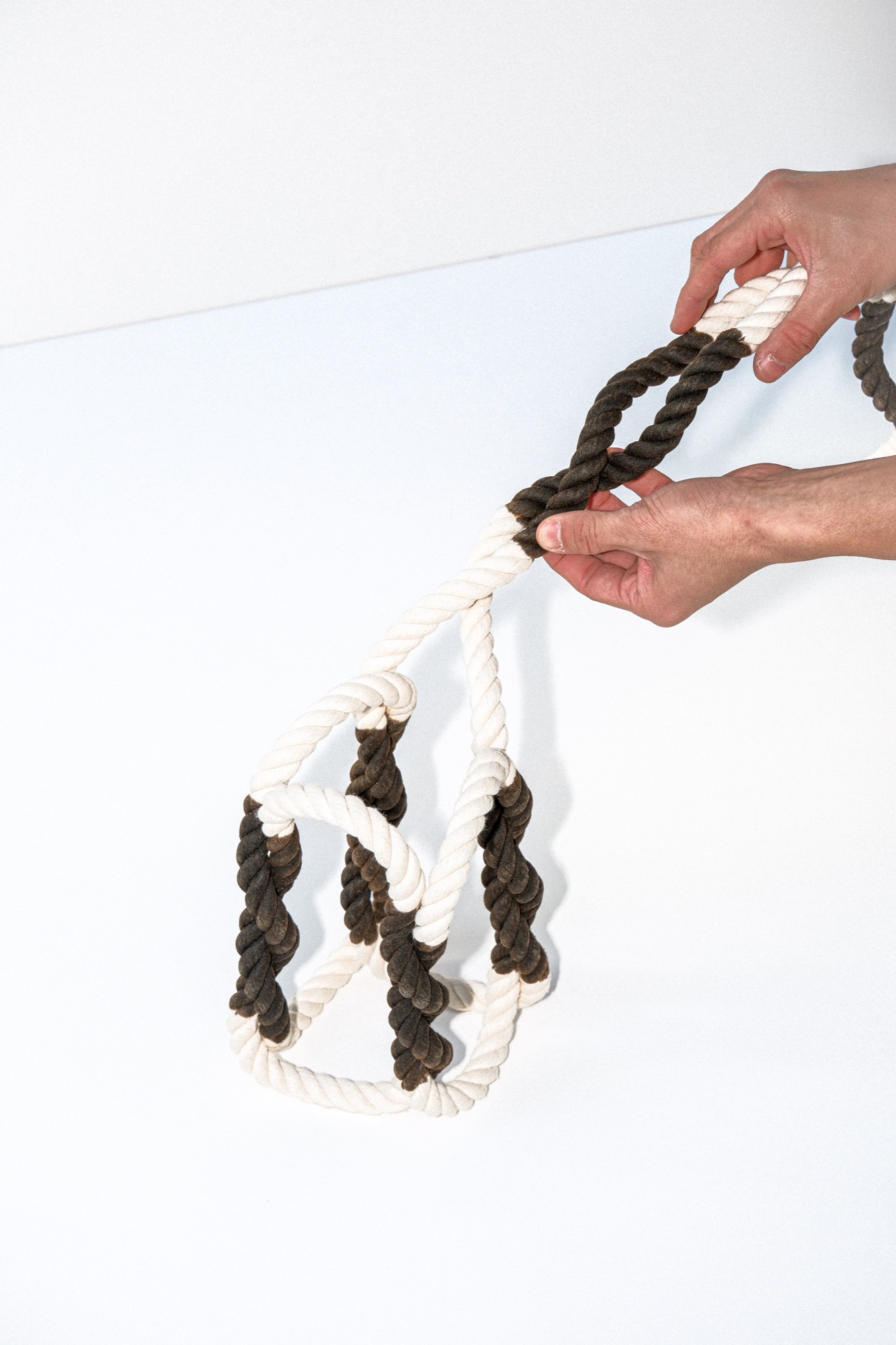
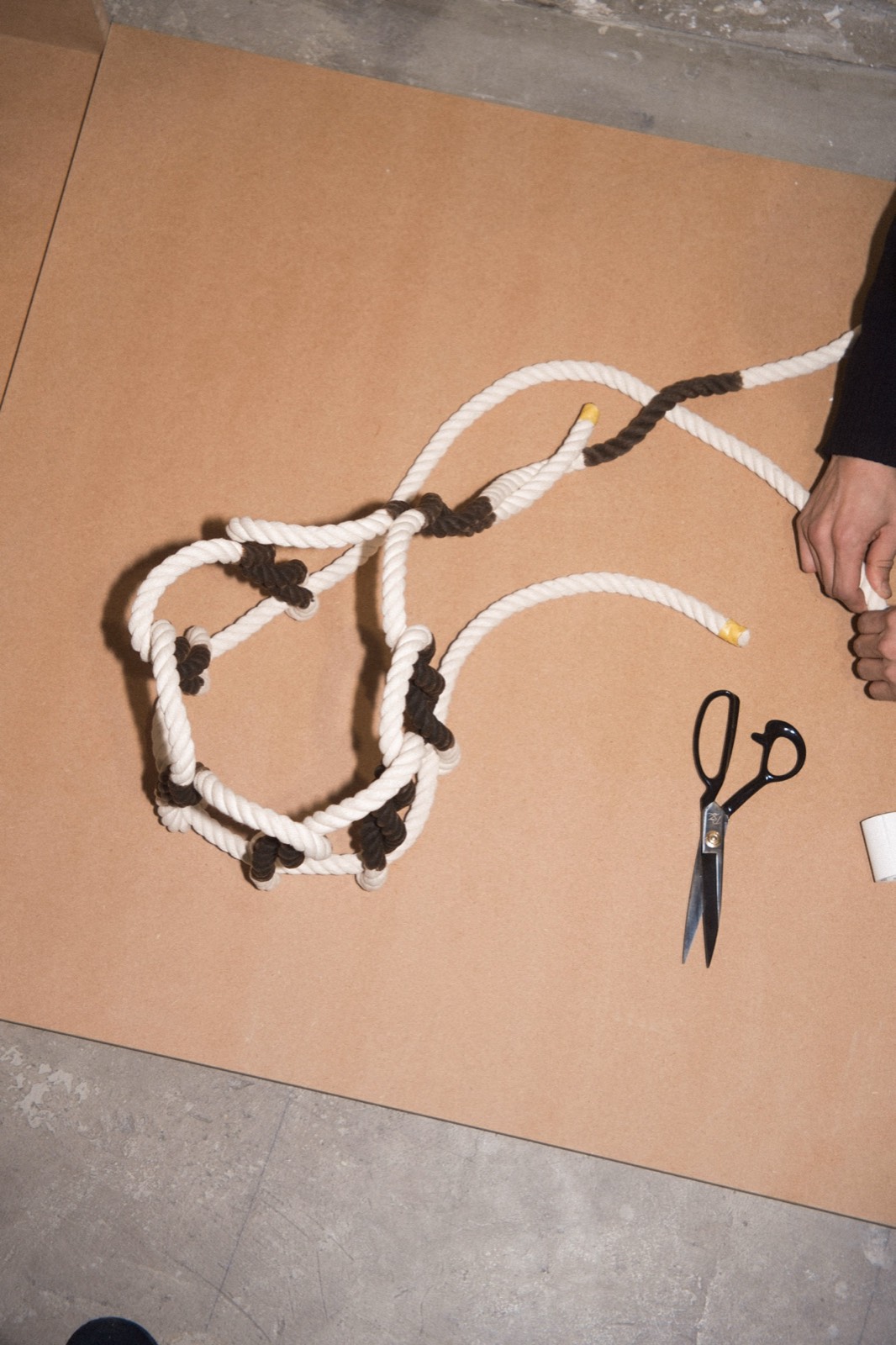
A single line rises into space through twisting, expanding into cubes, polyhedra, and basket-like forms. By varying the length and number of twists, density and scale change freely, generating innumerable variations from a simple rule. NEJINEJI presents not a finished object, but the very process of a line transforming into structure.
一本の線は、ねじりを介することで空間に立ち上がり、立方体や多角柱、バスケット状のかたちへと拡張します。ねじりの長さや数を変えることで密度やスケールは自在に変化し、単純なルールから無数のバリエーションが生まれます。 「NEJINEJI」は、ひとつの完成形を示すオブジェクトというよりも、線が構造へと変化していくプロセスそのものを提示する作品です。
- ー